

The third shot at Trump: do we believe it or not?
April 25, 2026. Washington's Hilton Hotel. The White House Correspondents' Dinner — an annual ritual of American political and media life — is underway. Some 2,600 guests fill the ballroom: journalists, cabinet secretaries, the president and first lady, the vice president, the FBI director, the secretary of state, the secretary of defense. On stage, mentalist Oz Pearlman is performing. Then comes the sound: five shots, fired just outside the main security screening area.
Cole Tomas Allen, 31, born in April 1995, a Caltech-educated mechanical engineer and video game developer from Torrance, California, has stormed the magnetometer checkpoint carrying a shotgun, a handgun, and multiple knives in a black bag. One Secret Service officer is struck in his bulletproof vest and will recover. Trump, Melania, Vance, Rubio, Hegseth, and Kash Patel are evacuated. Allen is arrested. The Department of Justice charges him with the attempted assassination of the president of the United States — a crime carrying a sentence of up to life in prison.
Within minutes of the first reports, before anything was known about the suspect or his motives, the word "STAGED" had already begun trending across social media platforms.
This is the third reported assassination attempt against Trump in under two years. And the third time, a significant portion of the American public's first instinct was not to ask who and why — but whether the event was real at all.
What Actually Happened: The Facts in Full
Allen had checked into the hotel the day before the event. Surveillance footage shows him leaving his tenth-floor room dressed in black, carrying his weapons in a bag. He used an interior stairwell to bypass the most heavily monitored areas of the hotel and exited onto the level of the foyer leading to the dinner's red carpet.
Before arriving in Washington, Allen had traveled by train — the Southwest Chief from Los Angeles to Chicago, then onward to the capital — and had been staying at the hotel as a registered guest.
A manifesto, purported to be Allen's and reviewed by law enforcement, reads in part: "I am a citizen of the United States of America. What my representatives do reflects on me. And I am no longer willing to permit a pedophile, rapist, and traitor to coat my hands with his crimes." The document does not name Trump directly, but its grievances leave no ambiguity about the target.
Allen had donated $25 to a Democratic PAC supporting Kamala Harris in October 2024, according to Federal Election Commission records. He earned a degree in mechanical engineering from Caltech in 2017, followed by a master's in computer science in 2025. A professor who taught him described him as "a very good student, always sitting in the first row, frequently emailing with coursework questions." Neighbors said he had moved into his Torrance neighborhood just six months earlier.
Acting Attorney General Todd Blanche stated that authorities believe Allen had set out to target members of the Trump administration, "likely including the president." Trump himself called for unity and bipartisan healing in an unusually conciliatory response — his third such experience in under two years.
The Architecture of Suspicion: Why "Staged" Spread in Minutes
There is no evidence that the incident was staged. Authorities released ample evidence almost immediately. And yet the conspiracy theory spread faster than any fact-check could follow.
Several details created the kindling. White House press secretary Karoline Leavitt, in a red carpet interview before the shooting, told Fox News that "shots will be fired tonight in the room" — a reference to the president's planned comedic speech. Her husband, seated next to Fox correspondent Aishah Hasnie at the dinner, reportedly emphasized that Hasnie "needed to be very safe" that evening. When Hasnie began recounting this detail live on air, her phone line cut out. Within minutes, social media users had constructed an entire theory of foreknowledge and suppression from these three fragments — each one individually innocent, together read as damning.
Fake images of Allen spread online. AI-enhanced security footage of his sprint through the checkpoint circulated widely. One post on X theorizing that time travel was involved in the incident had accumulated more than 1.2 million views by the following morning. A pro-Iran AI propaganda video seized on the moment. An AI-generated clip of Tucker Carlson promoting the staged theory also circulated.
The Daily Beast's executive editor, Hugh Dougherty, was in the ballroom when the shots were fired. His immediate response, crouched on the floor, was to tell his colleague: "It's a stunt." He later wrote: "I get it. I said it myself, just seconds after the shots were fired. There are lots of ways in which, at first glance, what happened at the Correspondents' Dinner seems impossible to believe could be real." He went on to note that Allen had been sleeping in the room directly next to his the night before — on the other side of the wall where the manifesto was written.
Allen was stripped naked after his arrest — standard protocol for a suspect who might be carrying a suicide device. The foil blanket wrapped around him was standard emergency gear, not theatrical staging. Vance was evacuated before Trump, not because of any conspiratorial prioritization but because, simply, he is younger and more physically mobile. The ballroom itself was not evacuated because it was the only area that had been checked for explosives — making it, paradoxically, the safest place in the building.
The White House dismissed the theories without ceremony. Spokesperson Davis Ingle said, "Anyone who thinks President Trump staged his own assassination attempts is a complete moron." Trump himself called the conspiracy theories "sick." Leavitt labeled them "crazy nonsense."
None of it made a measurable dent in the spread.
Who Was Cole Allen — and What His Profile Tells Us
This is where the story becomes genuinely uncomfortable to tell, because it doesn't fit a convenient political narrative in either direction.
Allen was not a marginal figure. He was not an isolated extremist operating from the fringes of society. He was educated at two serious universities, employed as a teacher, and awarded "Teacher of the Month" at a tutoring company four months before the attack, and described by everyone who knew him as quiet, diligent, and unremarkable. He planned his operation methodically: purchasing his shotgun seven months in advance, traveling across the country by train, checking into the hotel a day early, writing a thousand-word document to his family before he left his room for the last time.
His manifesto does not read like psychotic ideation. It reads like someone who has followed a chain of political logic — "Trump is a traitor, complicity is immoral, action is therefore duty" — all the way to its most violent conclusion. Whether or not that logic is coherent or justifiable is beside the point. The point is that it is recognizable. It is the endpoint of a kind of political radicalization that is not limited to militia basements or dark forums. It happens in the minds of educated, outwardly normal people who have absorbed years of maximal political rhetoric and reached the conclusion that the stakes are too high for any other response.
That is not an accusation aimed at Democrats or at any particular political movement. It is an observation about what happens to a society that has been told, repeatedly and from the highest levels, that the other side is not merely wrong but existentially dangerous.
A Society That No Longer Shares a Reality
CNN's Aaron Blake wrote after the shooting about "an emerging split reality in the US," describing how the reaction to recent acts of political violence reflected "increasingly warped views of the perpetrators from people from both the left and the right," and how both sides were "overwhelmingly likely to blame the other for those acts."
Cenk Uygur, host of "The Young Turks," wrote: "It's a sign of the times that as soon as you heard there was a shooting at WHCD, you heard speculation it might be staged. Why? Because we've lost all faith in our government. We know they lie to cover up the crimes of the powerful. We don't trust anything anymore."
Mark Fenster, a scholar of conspiracy theories and government transparency at the University of Florida, observed: "It comes in waves in the U.S. We have had periods in which there has been both political violence and this sort of fear of conspiracy." What is different now, he noted, is the speed — minutes rather than days — and the algorithmic amplification that makes fringe reactions feel mainstream almost instantly.
The staged theory did not emerge from nowhere. It emerged from a decade in which institutional credibility has been systematically dismantled. When the leader of the country's governing party spent years telling his supporters that elections are stolen, that the FBI is corrupt, that the press is the enemy of the people, that judges are biased, and that any inconvenient fact is fake, he not only changed political opinions. He changed the epistemological environment in which political opinions are formed. He taught millions of people that institutional claims are inherently suspect, that coincidences are evidence of coordination, and that the most powerful and counterintuitive explanation is usually the correct one.
Once that cognitive framework is in place, it does not stay contained to the targets its original architect intended. It generalizes. The left absorbs it and applies it to Trump. The right applies it to Democrats. Everyone applies it to breaking news events before any evidence is available, because waiting for evidence has come to seem like naivety.
The Blame Game and Its Political Uses
The White House's response to the shooting illustrated — with painful clarity — the precise dynamic that makes this crisis so resistant to resolution.
The administration's official statement declared that the attack was "the predictable result of years of reckless, inflammatory, and escalating rhetoric from Democrats," and that Allen's manifesto was "indistinguishable from the words we hear daily from their party."
Leavitt told reporters: "The deranged lies and smears against the president, his family, his supporters have led crazy people to believe crazy things, and they are inspired to commit violence because of those words."
These statements may contain a grain of legitimate concern — political rhetoric has consequences, and extreme characterizations of political opponents do shape the environment in which disturbed individuals make decisions. But they also represent exactly the same dynamic the administration was criticizing: using an act of violence to mobilize your own base against your political opponents, before the investigation is complete, before the nuance is established, before anyone has had a moment to take stock.
Trump called for unity in the same breath in which his press secretary was issuing partisan accusations. He expressed concern about political violence while his Truth Social feed published photographs of the shirtless, handcuffed suspect lying face down on the ground — not the behavior of someone genuinely seeking de-escalation.
This is the essential feature of the current American political environment. Every act of violence, real or perceived, becomes immediately instrumental. It is folded into the existing narrative, assigned its proper villain, and transmitted to the base before the body is cold. The cycle does not just continue — it accelerates, because each iteration raises the emotional stakes and lowers the threshold for the next one.
Three Attempts, Two Years, One Pattern
The timeline of attacks against Trump is now undeniable: Butler, Pennsylvania, July 2024 — a spectator killed, Trump wounded in the ear, the attacker shot dead. West Palm Beach, Florida, September 2024 — Ryan Routh lay in ambush for nearly twelve hours near Trump's golf course, was spotted and arrested before firing; he was convicted and sentenced to life in February 2026. Washington, D.C., April 2026 — Cole Allen, the Correspondents' Dinner.
Three attempts in under two years is not a statistical anomaly. It is a pattern. And patterns require explanation — not just at the level of individual psychology (who were these men, what drove them) but at the structural level: what kind of political environment produces this rate of attempted political violence against a sitting or former president?
The answer, uncomfortable as it is for anyone on any side of the debate, is: an environment of total political war, where the language used by elected officials and major media figures has become saturated with existential stakes and dehumanizing characterizations of the opposition. When one side describes the other as fascists threatening the survival of democracy, and the other describes its opponents as traitors and enemies of the people, both are raising the perceived moral costs of inaction and the perceived moral acceptability of extreme measures.
None of this is an argument for false equivalence between the parties, or for pretending that rhetorical escalation is symmetrically distributed. It is simply an observation that the aggregate effect of years of mutual maximalism has created an environment in which some people — on both sides — have decided that normal political activity is no longer sufficient. Some of them decide to vote, donate, or canvass. Some of them decide to board a train with a shotgun.
What Conspiracy Theories Tell Us About the State of the Republic
The speed with which "staged" trended after the Correspondents' Dinner shooting is not primarily a story about gullibility or stupidity. It is a story about what happens to a society's epistemic infrastructure after years of deliberate attack.
Donald Trump did not invent political polarization or public distrust of government. Both had been building for decades. But he did something specific that his predecessors — even the most divisive ones — had not done to the same degree: he made the deliberate destruction of institutional credibility into a governing strategy. Every time an institution contradicted him — a court, an intelligence agency, a news organization, an election authority — he did not argue that the institution was wrong. He argued that the institution was corrupt, compromised, and part of a coordinated effort to destroy him and his supporters.
The cumulative effect of that strategy, applied consistently over nearly a decade, is a public that has lost the shared epistemic ground necessary for democratic politics to function. In a healthy democracy, citizens may disagree about values and policies. But they operate from a shared body of verified facts, adjudicated by institutions they broadly trust. When those institutions are delegitimized — when courts are "rigged," elections are "stolen," media is "fake," and science is "politically motivated" — the shared factual ground disappears. What remains is a landscape of competing narratives, each backed by its own ecosystem of sources and personalities, each telling its adherents that the other side is not just wrong but malicious.
In that landscape, conspiracy theories are not irrational. They are the natural product of rational people trying to make sense of events using the tools available to them — tools that have been systematically degraded. If you genuinely believe that the government lies about everything that matters, that major media outlets fabricate stories, and that your political opponents are capable of any crime, then the hypothesis that a third assassination attempt was staged is not absurd. It is the logical application of the priors you have been given.
The tragedy is that those priors were, in large part, deliberately installed.
What Comes Next
Trump survived the Correspondents' Dinner. He will likely emerge from it, as he has emerged from every previous crisis, politically stronger in the short term. The attempted assassination will harden his base, generate a wave of sympathy from moderates, and give his administration another opportunity to cast Democrats as accessories to violence. The conspiracy theories on the left will further alienate the political center. The mutual accusations will poison whatever remains of bipartisan possibility.
The shooter will go to trial. He will receive, in all likelihood, a lengthy prison sentence. His manifesto will be cited by each side as evidence of the other's responsibility. The underlying dynamics that produced him — and Routh, and Crooks before him — will remain entirely unaddressed.
This is the most alarming aspect of all. Not the individual events, terrible as they are. But the absence of any systemic response. No serious political leader in either party is proposing a de-escalation of rhetoric. No major institution is in a position to credibly demand it. The algorithmically optimized platforms that amplify the most extreme reactions have every financial incentive to continue doing so.
What America is watching, in real time, is a feedback loop of radicalization, violence, conspiracy, blame, and further radicalization — with no circuit breaker in sight.
The question that nobody in Washington seems prepared to answer is simple: at what point does a political culture that treats every act of violence as an opportunity become the primary producer of the violence it claims to deplore?
Sources: Al Jazeera, Wikipedia, NBC News, CBS News, CNN Politics, The Daily Beast, White House official releases, Reuters, University of Florida (Prof. Mark Fenster). All events cited occurred on or before April 28, 2026.
Daily news digest
Subscribe to receive a daily selection of articles every morning.
Share
This may be interesting for you

ПМЕФ-2026: Шафран від Талібану і Мистецтвознавець від США
Петербурзький міжнародний економічний форум відбувся 3–6 червня 2026 року у конгресно-виставковому центрі «Експофорум» поблизу Санкт-Петербурга. Це вже 29-й за рахунком захід. І, мабуть, найбільш пока
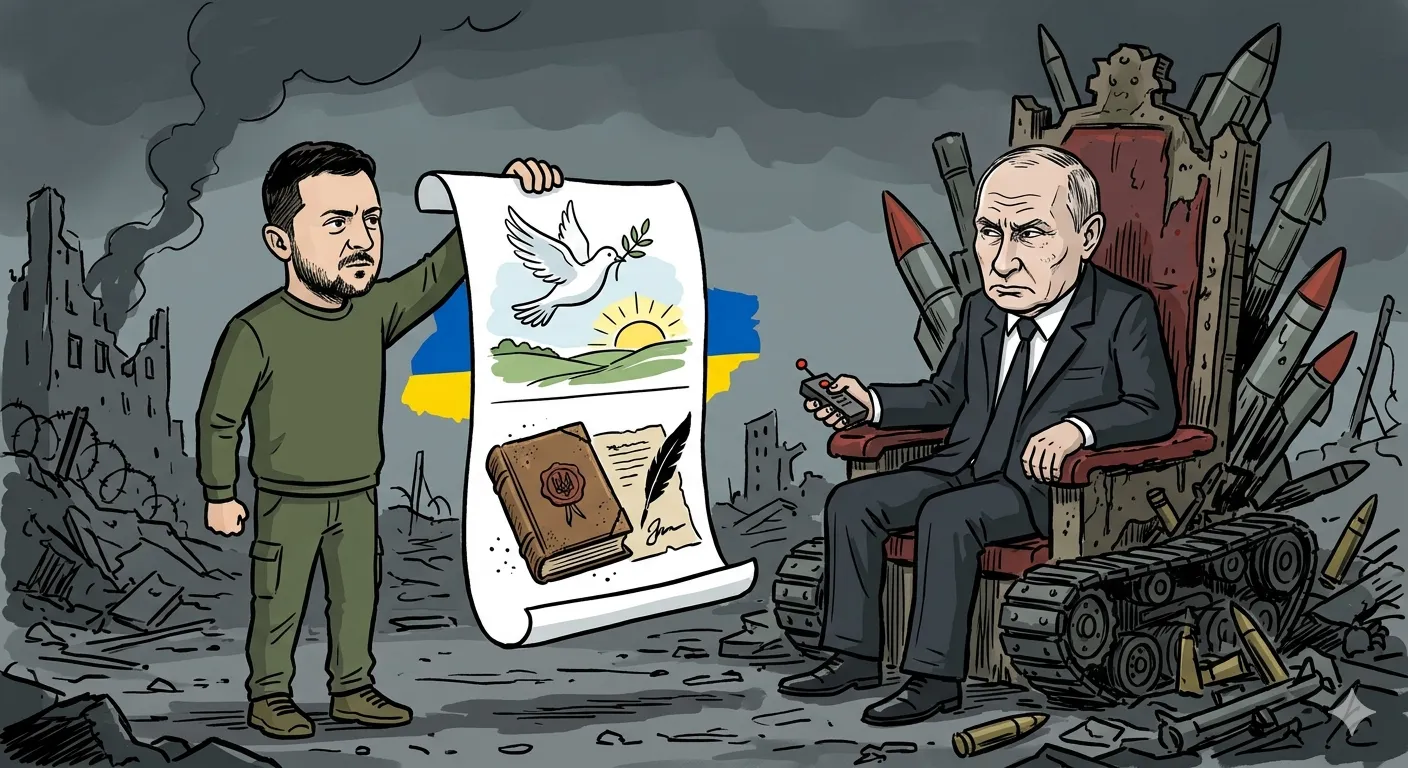
Zelensky's Open Letter to Putin: Peace Offer or Record for History?
 Liberalism·Jun 5, 2026
June 4, 2026. Ukrainian President Volodymyr Zelensky published an open letter to Vladimir Putin — a direct, public appeal for a face-to-face meeting and a full ceasefire for the duration of peace nego
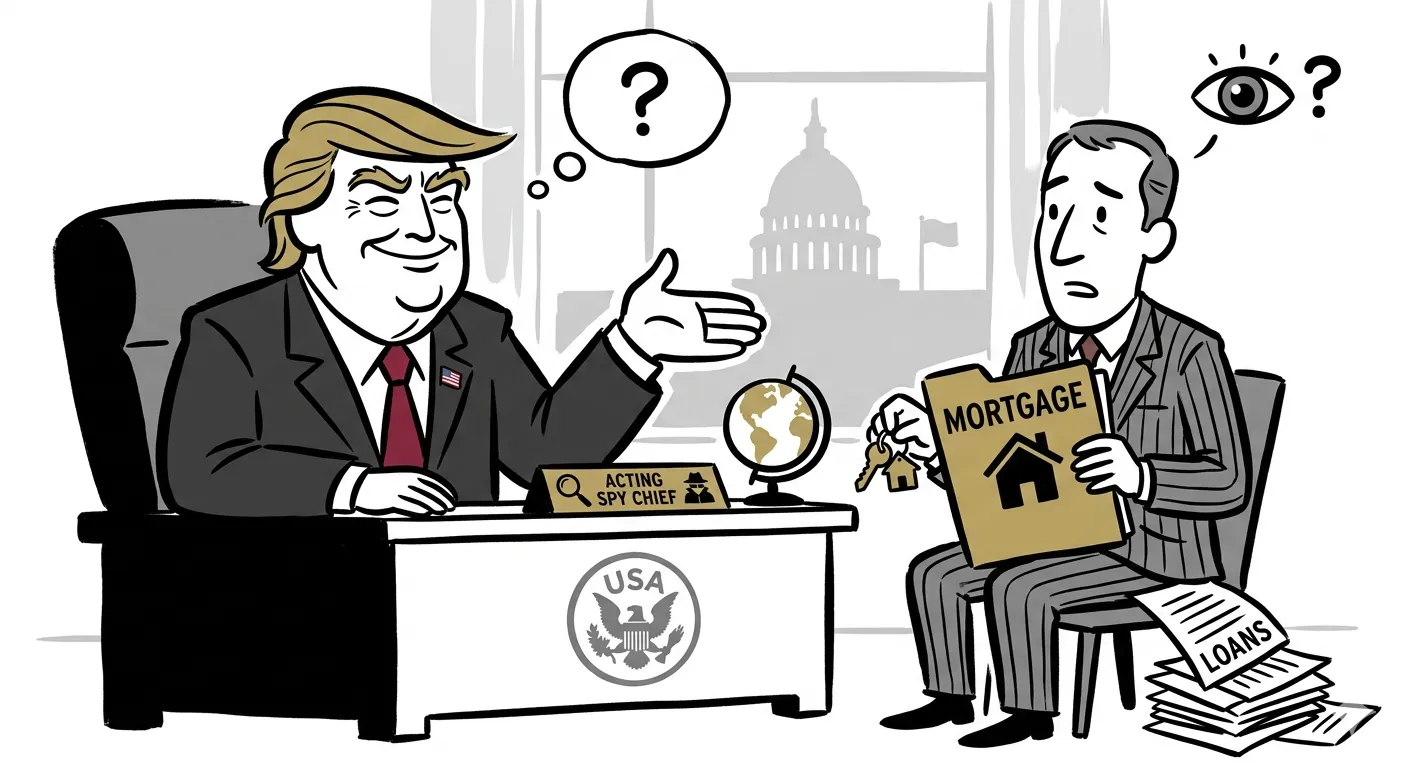
Trump Picks Mortgage Chief Pulte as Acting Spy Chief — No Intel Experience
Liberalism·Jun 4, 2026June 2, 2026. The United States has eighteen intelligence agencies. They collectively employ hundreds of thousands of people, operate in every corner of the world, and manage what intelligence profess
Trump Called Hezbollah "Very Good" — and Pressured Israel to Stop
Liberalism·Jun 2, 2026June 1, 2026. Shortly after 1:30 PM Eastern Time, President Donald Trump posted a pair of statements on Truth Social that are worth examining with unusual care — not because the Lebanon ceasefire they