

Trump’s Diesel Deal With Putin: Ukraine, Prices & the Cost
A Birthday Call, a Fuel Deal, and a Week of Funerals
On October 7, 2026, Russia launched one of its heaviest missile barrages of the year against Ukraine. The next day, a glide bomb attack on two passenger buses in Kramatorsk killed at least 33 people. By the end of the week, the UN told the Security Council that Russian strikes had killed more than 100 civilians across Ukraine in a single week.
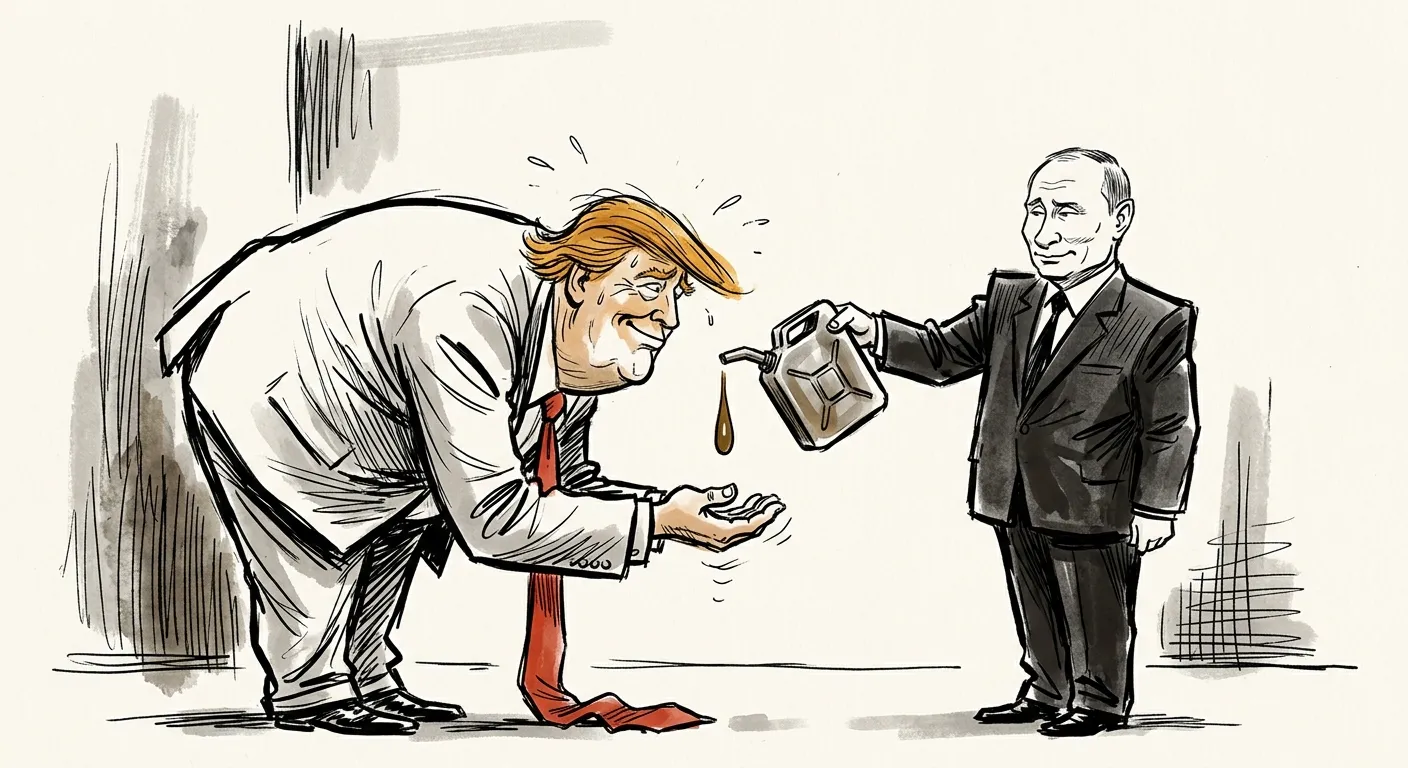
In the middle of that week, Donald Trump called Vladimir Putin. According to Kremlin aide Yuri Ushakov, Trump warmly congratulated Putin on his birthday — the same date as the October 7 barrage — and wished him success and well-being. Then he announced a deal. In what the Associated Press called a stunning reversal of years of US policy, Trump said Russia would supply more than 300,000 tons of diesel immediately, another 500,000 tons in November and 1 million tons after that. Within hours, the Treasury Department issued a license easing sanctions on Russian diesel.
The deal is the culmination of weeks in which American fuel prices, rather than Ukraine’s security, increasingly shaped Washington’s Russia policy. This article explains what was agreed and why, how Washington pressured Kyiv to stop striking Russian refineries, whether the deal will actually lower US diesel prices, how Russia used this moment, and what critics and defenders say about where this approach leads America.
The Deal: What Trump and Putin Agreed
Trump announced the agreement on Truth Social on October 9, after a call that was reportedly expected to focus on a suspected plague case in Russia. Beyond the first tranches, Trump said Russia would deliver 3 million more tons within a short period and claimed that, together with oil flowing again through the Strait of Hormuz, diesel prices would fall fast. According to CNBC, that brings the total to more than 4 million tons, with the extra 3 million tied to the condition of Russia’s refineries. (See the delivery schedule chart above.)
The Kremlin’s account was broader. It said Putin told Trump that Russia was ready to supply oil to American and global markets, and that the 90-minute call covered large-scale economic initiatives. On peace, Moscow offered only that Putin would consider when to resume negotiations. Putin’s envoy Kirill Dmitriev, who worked on the deal, praised Russian-American energy cooperation and promised it would continue.
The sanctions relief is concrete. Treasury’s Office of Foreign Assets Control issued General License No. 135, authorizing the sale, delivery, and import of Russian-origin diesel into the US until April 17, 2027. That comes only weeks after Trump signed sweeping Russia sanctions into law. The White House did not immediately say who would pay for the fuel or when it would arrive.
Why the Deal Happened: Kyiv Said No
The most revealing detail came the day after the announcement. According to Axios, a senior US official said Trump struck the deal because Ukraine refused to unilaterally stop attacking Russian oil refineries. Trump wanted those strikes halted because they were contributing to high fuel prices in America, and he did not consider Ukrainian refinery attacks equivalent to Russian strikes on Ukraine’s power grid.
Ukrainian officials described the pressure in starker terms: they said Trump’s envoys threatened to cut off US intelligence sharing if the strikes continued.
That pressure had been building for weeks. In September, Trump said in Ireland that Zelensky had to do “one thing” — stop hitting Russian diesel refineries — and could strike other targets instead. Axios reported that Trump repeatedly asked Zelensky during a call to stop attacking Russian refineries over their effect on diesel prices. In late September, Trump said he had told Zelensky to slow down and claimed the Ukrainian leader agreed. In mid-September, he even announced an energy “truce” that Zelensky denied within about an hour.
Kyiv’s position has been consistent: it will stop if Russia stops. Zelensky said Ukraine would not set Russian refineries on fire if Russia did not destroy Ukraine’s energy infrastructure. Washington wanted a one-sided pause instead. When Kyiv refused, the administration turned to Moscow.
And Ukraine is not backing down. According to the Financial Times, Ukraine plans to continue long-range drone strikes on Russian energy infrastructure despite the sanctions relief, with one official vowing to “burn” Russian refineries.
Why Ukraine’s Refinery Campaign Matters So Much
To understand why Kyiv refuses to give up these strikes, it helps to look at their effect. According to Ukraine’s General Staff, there have been more than 194 drone attacks on Russian refineries since January 1, 2026, hitting all eleven of Russia’s largest plants. The deepest strike, on the Omsk refinery in July, reached about 2,500 kilometers from Ukraine. The International Energy Agency estimates that Russian diesel output has fallen by about 30%, and Moscow has banned diesel exports since July.
Ukrainian military intelligence says jet fuel output dropped so far that Russia banned its exports and began importing foreign fuel — the same fuel that powers Russian warplanes and strike drones. In other words, these strikes directly reduce Russia’s ability to bomb Ukrainian cities.
The diesel deal undercuts that pressure. The Washington Post wrote that the deal could ease prices somewhat but effectively aligns Washington with Moscow against Ukraine’s bombing of Russian energy infrastructure. One energy analyst noted that the deal greatly benefits Russia, which is trying to offload summer-grade diesel while needing heavier winter and Arctic grades.
Talks Over Ukraine’s Head — and Europe’s
The timing of the announcement speaks volumes. Trump unveiled the diesel deal while his envoy Steve Witkoff and son-in-law Jared Kushner were meeting Ukrainian officials in Miami to discuss a plan to end the war. Zelensky said Ukraine’s negotiating team was being used as cover while Trump and Putin agreed on fuel.
This fits a pattern that has followed Trump’s second term from the start. In February 2025, his first call with Putin alarmed Kyiv and European capitals and deepened fears that Ukraine would be left out of talks on its own future. John Bolton said at the time that Trump had effectively conceded to Putin before negotiations had even begun. Before the August 2025 Alaska summit, European leaders scrambled to avoid being frozen out.
The pattern continued in 2026. In September, the Kremlin said Trump told Putin that ending the war would immediately open the way to fully restoring US-Russian relations. Europe, meanwhile, was treated as a source of leverage: Reuters reported that the administration told Germany and France to release emergency diesel reserves or risk a US export ban.
Will the Deal Lower Diesel Prices in the US?
This is the question American voters care about, and the honest answer is: somewhat, at the margins, and probably far less than Trump promises.
The price pressure is real. US retail diesel crossed $6 a gallon for the first time in early September and reached $6.23 by mid-September. By late September, it had climbed above $6.50. (See the September price chart above.)
Several factors limit what the Russian deal can do:
The volumes are small and uncertain. Atlantic Council analyst Joseph Webster said the promised Russian volumes may never materialize, are small, and would not solve the global diesel shortage. By a rough estimate, 300,000 tonnes is about 2.2 million barrels — roughly half a day of US distillate consumption, which runs close to 4 million barrels per day. Even the full 4-million-plus tonnes would cover only about a week of American demand, spread over months.
The real driver is the Iran war. The IEA identified two compounding causes of the shortage: restricted shipments through Hormuz and damage to Russian refining. Iran and its Houthi allies have also attacked refineries in the Middle East, further squeezing supply. Webster argued that Putin and others are opportunistically shifting the blame for high diesel prices onto Ukraine rather than the US-Israel-Iran war.
The US is already the biggest exporter. America exported 62.5 million tonnes of diesel in 2025, compared with Russia’s 34.2 million. (See the export chart above.) Because diesel is priced globally, extra Russian barrels can help a little, but they do not change the basic picture.
Russian supply depends on Russian refineries. The later 3-million-tonne tranche depends on the state of those refineries — which Ukraine has said it will keep striking. Russia has also extended its export ban for direct producers through October 31, with a broader fuel export ban in place until January 31, 2027. Deliveries can be delayed, cut, or used as leverage.
The politics are obvious. Bloomberg noted that diesel prices pose real political risk for Trump before the November midterms. He earlier floated a diesel export ban but backed off after the oil industry and business groups warned it would raise gasoline prices. In September, he predicted fuel prices would fall sharply after the midterms.
The bottom line: the deal might take some edge off prices if Russian diesel actually arrives. But it cannot fix the Hormuz disruption; it depends on the goodwill of a government at war, and it comes with an obvious strategic cost — easing pressure on Russia’s war economy.
Russia’s Answer: More Than 80 Dead in Four Days
While Washington was negotiating fuel deals, Russia was escalating its attacks on Ukrainian civilians. Here are the deadliest attacks of the week, according to the UN and Ukrainian authorities:
Civilians Killed in Major Russian Strikes on Ukraine, October 5–10, 2026
People killed
On October 5, a Russian rocket strike on the village of Pechenihy in the Kharkiv region killed 10 people. On October 7, Russia fired about 70 missiles and dozens of drones; the UN says at least 32 people were killed, including five children. The worst devastation was in Pryluky, where a missile destroyed a five-story apartment building and killed 19 people, according to Zelensky. The attack coincided with Putin’s birthday, and Zelensky called it a “birthday present” Putin gave himself.
On October 8, a glide bomb attack on two passenger buses in Kramatorsk killed at least 33 people, and drone strikes killed 6 more in Kyiv. On October 10, the day after the diesel deal, Russian strikes killed at least 17 people, including three children, in Zaporizhzhia and disrupted power and water in Kyiv. Zelensky said the new strikes were Russia’s “thanks” for the US diesel deal.
Taken together, Russian attacks killed more than 80 people between October 7 and 10 alone. The UN reported more than 100 civilians killed and at least 429 injured in a single week, with a UN official telling the Security Council that the attacks had reached “a new horrifying level”. UN monitors have verified 2,222 civilians killed and more than 13,000 injured in Ukraine so far in 2026.
This is the backdrop against which Washington eased sanctions on Russian fuel and pressed Ukraine to stop hitting the refineries that supply Russia’s war machine.
How Ukraine and Washington Reacted
Zelensky responded sharply. He wrote on X that sanctions relief for Russia without a lasting de-escalation agreement was unacceptable, warned that Russia would repay the diesel with more terror and treachery, and summed it up in one line: “Gifts to Putin will not bring peace.” He called the deal a weak decision.
The backlash in Washington was immediate. Senator Richard Blumenthal, a co-sponsor of the Russia sanctions law, said the decision makes the US complicit in Putin’s war and called the agreement with “a murdering dictator” “a stain on our nation’s character,” arguing that it directly contradicts Congress’s intent. Representative Don Beyer, the senior House Democrat on the Joint Economic Committee, called the announcement infuriating.
The Moral Question: The Critics’ Case Against Trump
For many Ukrainians, Europeans and a large share of Americans, the sequence of events raises questions that go beyond policy. In one week, Russia killed more than 100 civilians; the US president congratulated Russia’s leader on his birthday; Washington eased sanctions to buy his diesel; and, according to Ukrainian officials, US envoys threatened to cut off intelligence to the country under attack unless it stopped hitting the aggressor’s fuel plants. Critics make several arguments about what this reveals.
Moral inversion between aggressor and victim. According to a US official, Trump does not see Ukrainian refinery strikes as equivalent to Russian strikes on Ukraine’s grid — but in a direction critics find shocking: the refinery strikes, which hit military-industrial infrastructure, were treated as the problem requiring a unilateral halt, while Russian strikes on apartment buildings and buses were met with sanctions relief.
Domestic politics over principle. Record diesel prices weeks before the midterms, plus Trump’s own prediction that prices would fall after the vote, led critics to conclude the deal is driven by electoral math rather than a strategy for peace.
Rewarding Moscow without reciprocity. Russia gets sanctions relief and a lifeline for its fuel sector; in return, the Kremlin offers only to consider when to resume talks.
Undermining Congress and the law. By easing restrictions weeks after signing a sanctions law, critics say, the administration has hollowed out the bipartisan message Congress tried to send.
In the harshest version of this critique, Trump’s approach is not a strategy but a moral failure: a president willing to trade a democracy’s security for a few cents at the pump, and to offer warm birthday wishes to a leader whose missiles had just killed children. Many Ukrainians, burying their dead in Pryluky, Kramatorsk and Zaporizhzhia, share this view.
Where This Leads America
Whatever one concludes about Trump’s motives, the consequences for the United States deserve serious attention.
Erosion of trust among allies. Easing sanctions on Russia without consulting Kyiv, reportedly threatening to cut intelligence sharing with a partner under attack, pressuring Germany and France over fuel reserves, and announcing deals on social media all send the same message: American commitments are conditional and transactional. Allies who doubt Washington will hedge.
Weakened deterrence. If the US will ease sanctions on an aggressor to lower fuel prices, adversaries from Moscow to Beijing to Tehran will draw conclusions about how far Washington will go to defend partners when the cost becomes real.
Short-term relief, long-term costs. Even if diesel prices dip before November, a Russia that emerges from this war stronger and rewarded is more dangerous to NATO, and therefore to the US. The cost of a future confrontation will likely far exceed a few months of expensive fuel.
A domestic political test. Trump’s approval ratings have kept falling as fuel prices bite. If the diesel gamble produces neither markedly cheaper fuel nor peace, voters may judge it on both counts.
Conclusion
Trump’s diesel deal with Putin marks a turning point in how Washington handles the war in Ukraine. After weeks of pressing Kyiv to halt strikes on Russian refineries and, according to Ukrainian officials, threatening to cut off intelligence sharing, the administration eased sanctions to buy Russian fuel once Kyiv refused. It announced the deal while US envoys sat across the table from Ukrainian negotiators, in a week when Russian strikes killed more than 100 Ukrainian civilians.
The economics don’t support the promise of dramatic relief: the volumes are small and uncertain, deliveries depend on Russian refineries and Russian goodwill, and the main cause of the shortage remains the Iran war. The strategic cost, by contrast, is immediate — less pressure on Russia’s war economy and deeper doubts among allies about American reliability.
Critics see a moral failure that will cost America its standing; defenders see hard-nosed deal-making for American consumers. The deal will ultimately be judged on two things: whether Americans actually pay less at the pump, and whether Russian missiles and glide bombs stop falling on Ukrainian homes and buses.
Daily news digest
Subscribe to receive a daily selection of articles every morning.
Share
This may be interesting for you
Trump’s Diesel Deal With Putin: Ukraine, Prices & the Cost
 Liberalism·Oct 10, 2026
A Birthday Call, a Fuel Deal, and a Week of Funerals On October 7, 2026, Russia launched one of its heaviest missile barrages of the year against Ukraine. The next day, a glide bomb attack on two pass
Трамп тисне на Україну: навіщо Зеленського кличуть до Москви

Кінець вересня 2026 року приніс українській дипломатії ще одне неприємне дежавю. Під час Генеральної Асамблеї ООН у Нью-Йорку президент США Дональд Трамп, за інформацією джерел агентства Bloomberg, зн
Both Straits Closed: What Happens to the Global Economy When Hormuz and Bab el-Mandeb Shut at Once
Liberalism·Sep 15, 2026A Second Chokepoint Falls For decades, energy analysts treated the Strait of Hormuz as the single most dangerous pressure point in the global economy. In 2026 that fear became reality — and then it do
Trump's $5,000 Voter Payment: Funding, Economy & Will It Work
Liberalism·Sep 13, 2026What Trump Actually Promised During his lengthy address at the Republican midterm convention in Dallas in early September 2026, President Donald Trump made a headline-grabbing pledge: if Republicans h